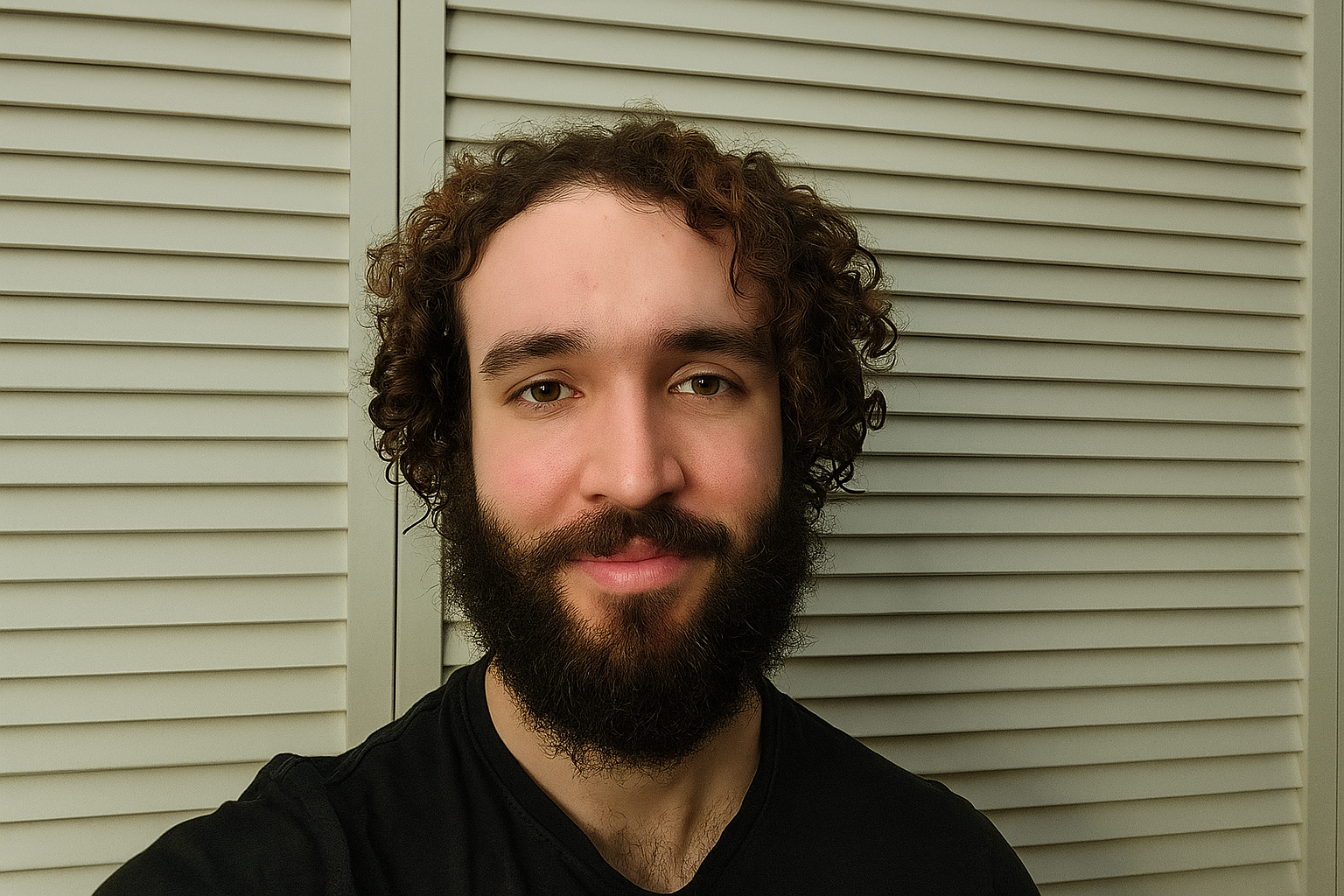
François d’Alayer de Costemore d’Arc is a PhD student in mathematics, more precisely in spatial statistics. He works in the laboratory Biostatistics and Spatial Processes (BioSP) at the French national research institute for agriculture, alimentation and environment (INRAE) in Avignon, France, with Samuel Soubeyrand and Edith Gabriel, and tells us how smart data collection can contribute to control plant diseases.
Why plant health?
At first, what drew me to this PhD project was a statistical problem, specifically, the use of sequential point processes for guiding data collection. Over time, my interest expanded beyond the statistical aspects, and I became engaged with the broader field of plant health surveillance. I discovered how important this domain is, particularly from economic and epidemiological perspectives. It involves objectives such as designing early warning systems and sequential monitoring strategies to better control plant diseases.
Which academic pathway led you to study Xylella fastidiosa?
I began with a bachelor’s degree in mathematics at Université Savoie Mont-Blanc. Then, I pursued a master’s degree in statistics at Sorbonne Université. This background led me to join INRAE as a PhD student, where I now focus on plant disease surveillance, with a particular emphasis on Xylella fastidiosa.
What is your thesis about?
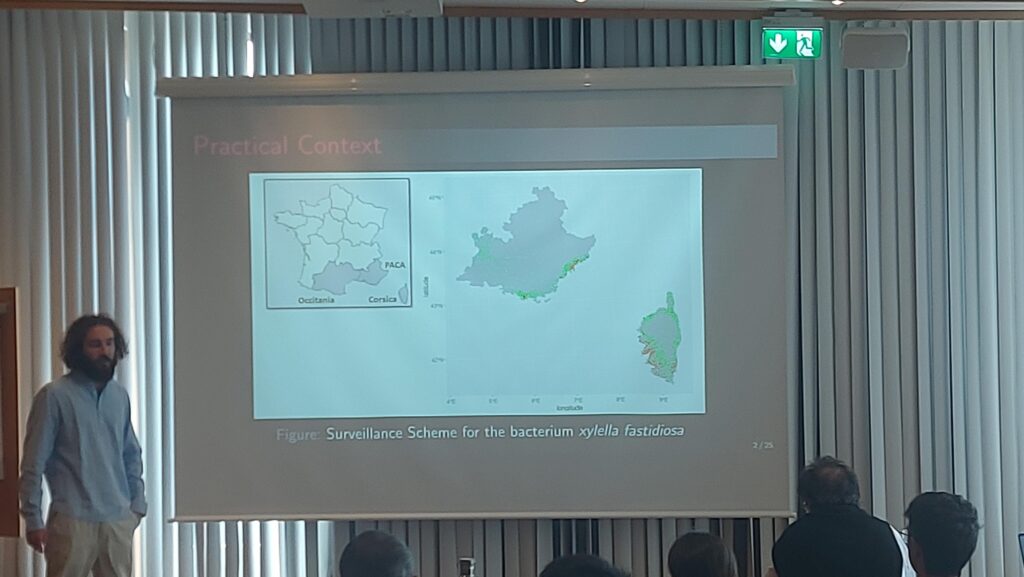
My thesis focuses on improving the efficiency of plant health surveillance methods. More specifically, I study how to optimally choose which trees to test using molecular diagnostics, knowing that we can only afford to test a very small fraction of a much larger population. This raises the problem of making smart, data-driven sampling decisions. I’m particularly interested in sequential methods, where each new sampling decision uses information gathered from previous samples. For instance, one approach might be to avoid testing trees that are too close to already-sampled ones, in order to better explore the population. Ultimately, the aim of my research is to help design comprehensive surveillance strategies that can tackle several problems at once, such as early detection, estimating prevalence, and managing different strains of X. fastidiosa simultaneously.
What are your main accomplishments or results?
I have worked on three major surveillance problems. The first of them, early detection, implies detecting the disease as quickly as possible. The second area involved in my research is the sample size calculation, determining how many samples are needed to ensure a low risk of missing the disease. The third element is the spatial prevalence estimation, meaningaccurately estimating how infection risk varies across space. In collaboration with IVIA’s Martina Cendoya Martinez and Antonio Vicent, we extended the current EFSA methodology for calculating sample size. Our approach accounts for both random and more aggregated disease patterns. In prevalence estimation, we found that an efficient sampling strategy should make a balance between targeting likely infected areas and exploring regions with high uncertainty.
What have been the main challenges in your research?
The most difficult part has been developing an approach that is both theoretically sound and practical: Something that makes sense from a scientific standpoint but is also easy to implement and explain to non-specialists.
How did you overcome these challenges?
To tackle this, I examined existing methods and tried to generalize them in a structured way. My goal was always to maintain a balance between theoretical rigor, clarity, and ease of application, ensuring the solutions remained accessible and actionable.
What are your plans after the PhD?
After completing my PhD, I would like to continue doing research, either in academia or in research institutes, in France or abroad. I’m particularly motivated by projects that combine methodological innovation with real-world applications.