Exploring the microbiome, the set and interactions of microorganisms (fungi, bacteria, viruses, etc.) living in our body, is a rapidly evolving research area that promises to reshape our understanding of health and diseases. The study of the plant microbiome offers the same opportunities for pest management.
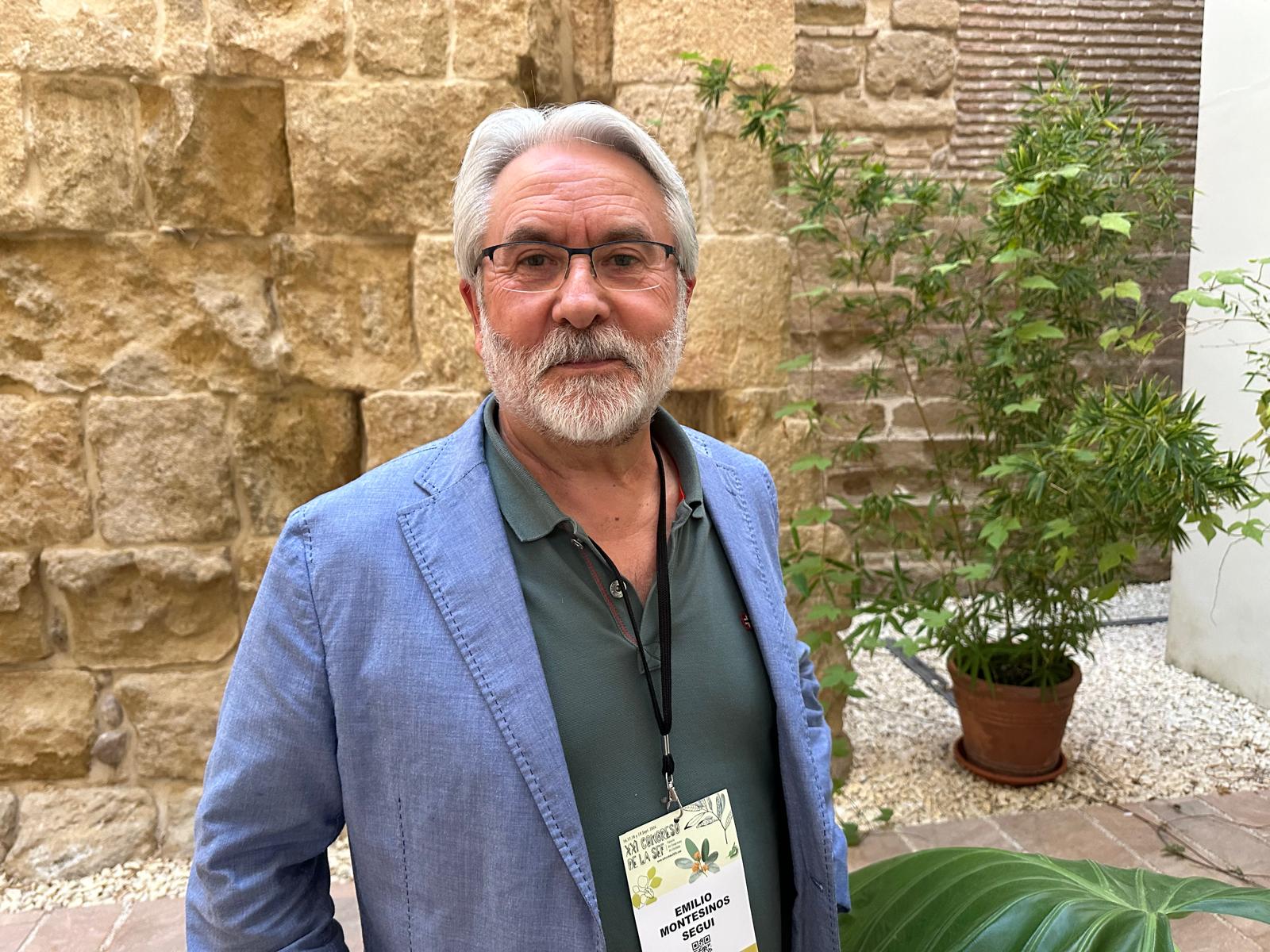
On this topic, we spoke with Emilio Montesinos, a full Professor of plant pathology at the University of Girona (Spain) and leader of the BeXyl work package on the plant microbiome.
As part of the work package you lead, you and your team are investigating “synthetic communities” of Xylella fastidiosa (Xf) antagonists. Could you explain what we are talking about?
Xf host plants’ xylem microbiome is composed mainly of bacteria that potentially interact with Xf during infections. Some of these bacteria can have antagonistic effects on Xf either by inhibition or competition for nutrients or space or by stimulating the plant’s defence mechanisms.
Therefore, upon isolating these antagonistic bacteria in pure culture and its characterization, we can prepare synthetic communities or consortia (SynComs) to protect the plant host against infection. The issue is how to introduce the SynComs into the xylem of the plant, but one approach is endo-therapy, which involves injection into the trunk.
You are also working on functional peptides. What are they, and how can they help?
Functional peptides are made of amino acids linked by short peptide bonds and can have inhibitory activity against Xf. Animals, plants and microorganisms naturally produce most, but analogues with improved properties can also be developed and synthesized in the laboratory. They can inhibit the growth of Xf or be bactericidal, but others induce defense responses in plants. Through these mechanisms of action functional peptides can protect plants against infection by Xf.
The BeXyl research is taking the contrast to Xf to a new level, the plant’s microbiome. Are such solutions already available?
The studies of the plant microbiome have progressed enormously with the omics approaches, particularly metagenomics, showing a vast diversity and abundance of microorganisms, most of which are non-culturable. However, to find practical applications in Xf disease control, some relevant microorganisms should be culturable and able to prepare inoculants based on SynComs. These approaches are already used in other agricultural fields like biofertilizers or biostimulants, and are expected to play a role in Xf control.
Another facet of the same challenge is developing practical biocontrol tools. How can we verify that potential solutions are effective in the field?
The potential solutions developed in the first stages of the Bexyl project as “proof-of-concept” in the greenhouse with potted plants, must be tested in the field. Field testing with Xf is very complex due to many issues because the disease is affected by the pathogen diversity (subspecies and ST), the vector, the environment and the host (nearly 700 species). The option is to perform field tests in demarcated areas where disease is present. However, tests for curing infected trees are a big challenge due to the high variability inherent to the experimental plots.
Therefore, in the BeXyl project, the idea is to protect plants or plantlets at the very late nursery stages – either inoculated with the SynComs, botanical extracts, peptides or phages – or after transplanting and to bring them to areas where Xf is present, such as Alicante, Balearic Islands in Spain, Puglia in Italy, to monitor its performance.
How far away or close are we to allowing the farmers to apply these solutions on the farm?
To be realistic, we have to finish the ongoing proof-of-concept experiments and the expected field tests to decide which are the best options. However, in the case of success, we will face two issues before it will arrive to the growers: the EU regulatory framework in case of finding a company wishing to commercialize the technologies (SynComs, phages, botanicals or peptides) and their industrialization. It will take some years.
However, these technologies are not definitive solutions to the problem. Instead, they are complementary actions within an integrated strategy combined with vector control, tolerant or resistant plant material use, and other agronomical practices.